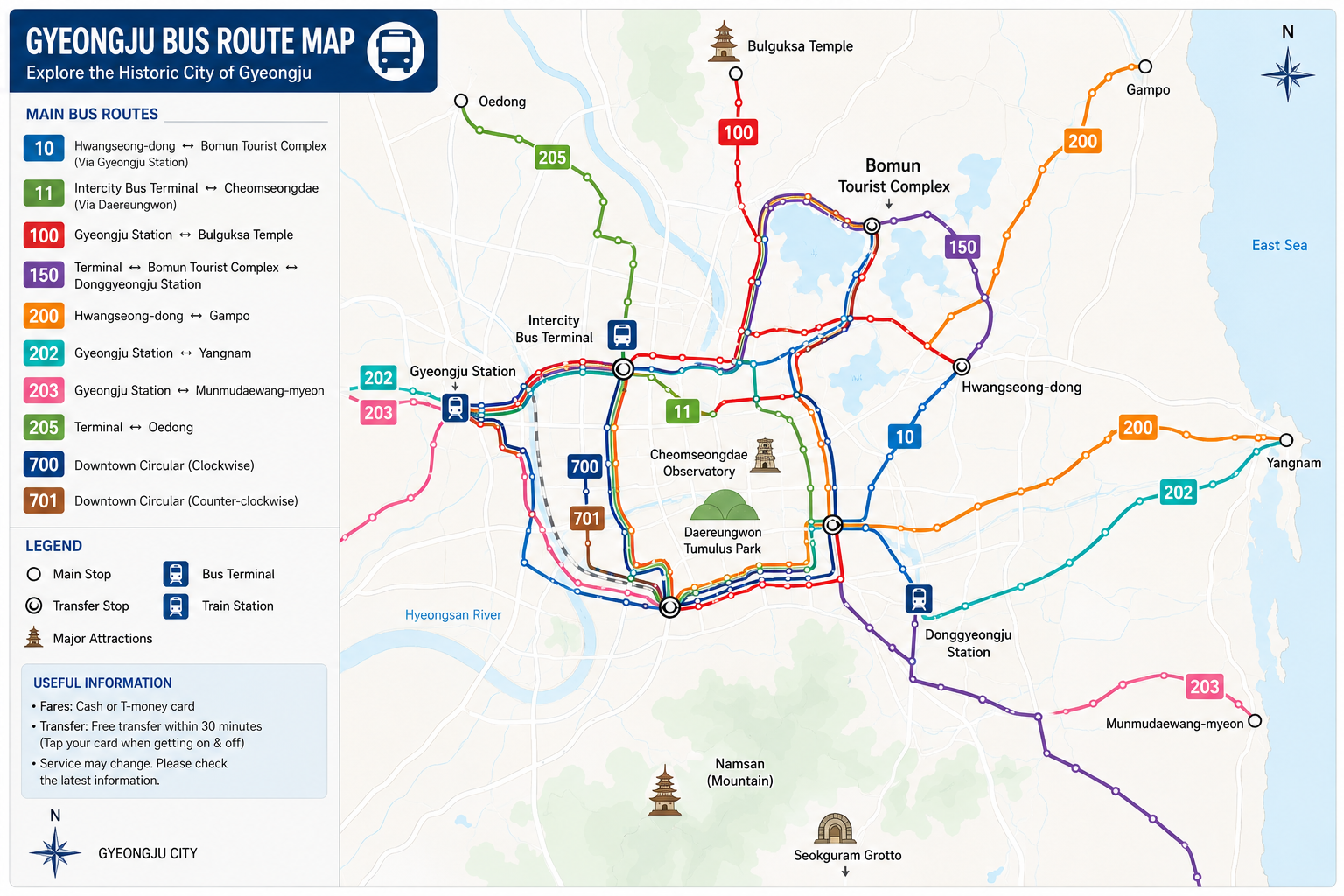
Gyeongju does not have a subway system. Its royal tombs, Buddhist temples, traditional streets, lakeside resorts and coastal attractions are spread across a much larger area than many first-time visitors expect.
This does not mean that you need to rent a car. The historic center is highly walkable, city buses connect the main tourism districts, and taxis can solve the most difficult final sections of a route. The challenge is knowing which journeys should be completed on foot, which bus routes are useful and when paying for a taxi saves enough time to justify the additional cost.
This guide explains how to travel from Gyeongju Station to downtown, how to use the city’s bus network, which English-language transportation apps are most reliable and how to reach places such as Hwangnidan-gil, Daereungwon, Bulguksa Temple, Seokguram Grotto, Bomun Lake, Gyeongju World, Yangdong Village and the Gampo coast.
Prices were checked on July 26, 2026. US-dollar conversions use a planning rate of US$1≈₩1,459. Your bank, international card, ATM or currency-exchange service may use a different rate and add fees.
Quick answer: Use a transportation card for ordinary city buses, KakaoMap or NAVER Map for route planning, and the official Gyeongju City Traffic Information Center for current route and arrival confirmation. A single adult bus ride costs ₩1,450 with a transportation card, or approximately US$0.99. A regular taxi begins at ₩4,500, or approximately US$3.08.
- How to Use Gyeongju Public Transportation
- Gyeongju City Bus Fares and Free Transportation
- Best Gyeongju Bus Routes for Tourist Attractions
- Best English Apps for Gyeongju Bus Information
- Gyeongju Station to Hwangnidan-gil, Bomun and Bulguksa
- How to Travel Around Gyeongju Without a Car
- Gyeongju to Busan, Daegu, Pohang and Nearby Cities
- Two-Day Gyeongju Transportation Budget
1. How to Use Gyeongju Public Transportation for Foreign Tourists
Gyeongju’s transportation system is built around city buses, regional trains, express and intercity buses, taxis, walking routes and a limited number of tourism or pilot shuttle services.
The city’s most important transportation points are:
- Gyeongju Station, which serves KTX, SRT and other rail services
- Gyeongju Intercity Bus Terminal
- Gyeongju Express Bus Terminal
- The former downtown railway-station area near Seongdong Market
- Hwangnidan-gil and Daereungwon
- Bomun Tourist Complex
- Bulguksa Temple
- Gampo and the eastern coast
Do not confuse the current high-speed Gyeongju Station with the former central railway station. Older maps, blogs and hotel descriptions may still use the name Singyeongju Station for the current KTX station. The station was renamed Gyeongju Station, but it remains outside the historic downtown area.
The old downtown station no longer performs the same intercity rail role. This distinction matters because entering only “Gyeongju Station” in an older guide may lead to incorrect assumptions about walking distance.
| Transportation type | Current planning price | Approximate USD | Best use |
|---|---|---|---|
| City bus with transit card | ₩1,450 | $0.99 | Main attractions and station transfers |
| City bus with cash | ₩1,500 | $1.03 | Backup payment |
| Youth or child with eligible registered card | ₩0 | $0 | Eligible passengers using a registered card |
| Regular taxi | From ₩4,500 | From $3.08 | Luggage, groups and remote attractions |
| Autonomous Bomun shuttle | Free during the current pilot | $0 | Selected Bomun Tourist Complex stops |
| Gyeongju–Busan KTX example | ₩10,100–₩11,000 | $6.92–$7.54 | Fast regional connection |
| Gyeongju–Dongdaegu KTX example | From about ₩8,400 | $5.76 | Daegu day trip |
| Gyeongju–Ulsan KTX example | From about ₩8,400 | $5.76 | Fast station-to-station travel |
| Gyeongju–Pohang KTX-Eum example | From about ₩8,400 | $5.76 | Pohang day trip |
The central heritage district is best explored on foot. Daereungwon, Hwangnidan-gil, Cheomseongdae, Gyerim Forest, Gyochon Village, Woljeonggyo Bridge and the Wolseong area form a relatively compact sightseeing cluster.
Buses become more important for Bomun, Bulguksa, Seokguram, Yangdong Village, Gampo, the East Sea coast and Gyeongju Station.
The most economical strategy is to divide Gyeongju into geographical zones:
- Historic downtown and Hwangnidan-gil
- Bomun Lake and Gyeongju World
- Bulguksa and Seokguram
- Gampo and the East Sea coast
- Yangdong Village and northern Gyeongju
Crossing between these areas several times in one day increases waiting time and makes taxis more tempting.
2. Gyeongju City Bus Fares and Free Transfer Rules
From April 1, 2026, the adult city-bus fare is ₩1,450 with a transportation card and ₩1,500 when paying cash. This equals approximately US$0.99 by card or US$1.03 in cash at the exchange rate used in this guide.
Eligible children and teenagers can ride free when they use an appropriately registered child or youth transportation card. Cash fares remain ₩800 for children and ₩1,200 for teenagers. A visitor should not assume that age alone will automatically produce a free fare; the card must be configured for the eligible passenger category.
T-Money, Cash and Gyeongju Bus Transfer Rules Compared
| Payment method | Adult fare | Transfer benefit | Main advantage | Main problem |
| T-money or compatible transit card | ₩1,450 / $0.99 | One eligible free transfer | Cheapest and easiest | Requires balance |
| Cash | ₩1,500 / $1.03 | No normal card-based transfer benefit | Useful as backup | Slower and less convenient |
| Registered youth card | ₩0 | Subject to card rules | Free for eligible passenger | Registration required |
| Registered child card | ₩0 | Subject to card rules | Free for eligible passenger | Registration required |
Gyeongju permits one eligible transfer within 30 minutes after tapping off. Transferring to another bus on the same route does not qualify. When paying for several passengers with one card, only one passenger normally receives the transfer benefit.
Always tap the transportation card when boarding and when leaving the bus. The exit tap records the end of the journey and begins the transfer window.
This procedure is important when traveling from Gyeongju Station to downtown and then transferring to another tourist route. Forgetting to tap when leaving may remove the transfer benefit or cause a later fare-calculation problem.
Transportation cards can generally be purchased and recharged at convenience stores. Cash is still useful because not every top-up transaction accepts an overseas credit card.
Carry at least ₩10,000–₩20,000, or approximately US$6.85–US$13.71, as a transportation backup. This is enough for several bus journeys or part of a short taxi ride.
Gyeongju does not currently have a simple tourist unlimited-transit product comparable to Seoul’s short-term Climate Card. For most international travelers, a standard rechargeable transportation card remains the most practical choice.
3. Best Gyeongju Bus Routes for Tourist Attractions
Gyeongju has many city-bus routes, including small variations that operate through different villages or only at selected times. Tourists do not need to memorize the entire network.
The most useful route families are:
- Bus 10 and Bus 11 for the classic heritage–Bomun–Bulguksa loop
- Bus 12 for Bulguksa Temple and Seokguram Grotto
- Bus 100 and 100-1 for sections of the eastern tourism corridor
- Express Bus 1100 for Gyeongju Station, downtown and Gampo
- Express Bus 1150 for Gyeongju Station, Bomun, Bulguksa and Yangnam
- Bus 500 for parts of the Namsan and Samneung area
- Bus 203 for selected services toward Yangdong Village
- Local station routes such as 50, 51, 70, 700, 710 or 711, depending on the current timetable
Current route variations and departure times must be checked through the Gyeongju City Traffic Information Center. The official route database lists multiple versions of some bus numbers, which means that two departures with a similar number may not stop at every identical location.
Bus 10 vs Bus 11 for Sightseeing in Gyeongju
Bus 10 and Bus 11 are the best-known tourist routes in Gyeongju. They travel around a broad loop in opposite directions.
The traditional Bus 10 sequence connects the terminal and central area with attractions including Cheomseongdae, Bunhwangsa Temple, East Palace Garden, Bomun Tourist Complex, Gyeongju World, the Expo area and Bulguksa Temple. It then returns through locations including the National Museum and Donggung Palace and Wolji Pond.
Bus 11 serves a broadly similar circular corridor in the opposite direction.
| Destination | Usually more useful route direction | Planning note |
| Cheomseongdae and central heritage area | 10 or 11 | Walking may be faster from Hwangnidan-gil |
| Bunhwangsa | 10 loop direction | Check live direction before boarding |
| East Palace Garden | 10 or 11 depending on origin | Useful for the entrance to Bomun |
| Bomun Tourist Complex | 10 or 11 | Confirm the hotel-side stop |
| Gyeongju World | 10 or selected related routes | Check last return bus |
| Bulguksa | 10 or 11 | Not every route variation is identical |
| National Museum | 10 or 11 | Can be combined with a downtown walk |
| Donggung Palace and Wolji Pond | 10 or 11 | Evening return services require checking |
The direction is more important than the route number alone. Boarding the circular route in the wrong direction can add a long trip through Bulguksa or Bomun before reaching a nearby attraction.
Before boarding, check:
- The destination displayed on the front of the bus
- The next three or four major stops
- The real-time route line in KakaoMap
- The bus-stop identification number
- Whether the route is a special variation
The official tourism page historically described the Bus 10 interval as approximately 20 minutes, but intervals and operating patterns can change. Treat old fixed timetables as background information and use live data for the date of travel.
How to Get from Bulguksa to Seokguram by Bus 12
Bus 12 operates between the Bulguksa area and Seokguram Grotto. The trip itself takes roughly 20 minutes under normal conditions, but the service is much less frequent than a central city bus.
The usual procedure is:
- Visit Bulguksa Temple.
- Walk to the bus stop near the Bulguksa public parking area.
- Check the next Bus 12 departure.
- Ride to the Seokguram stop.
- Visit Seokguram.
- Confirm the return departure before entering the site.
Do not arrive at Seokguram without checking the return bus. Missing a departure can create a long wait or require a taxi.
A Bus 12 ride costs the ordinary Gyeongju city-bus fare when paid under the normal city-bus system. A taxi can be a practical alternative for two to four travelers, especially when the next bus requires a long wait.
Bulguksa and Seokguram are on Tohamsan Mountain. Weather, road conditions and seasonal traffic can change the journey. Allow more time in rain, snow, peak autumn foliage or major holiday periods.
Gyeongju Coastal Buses to Gampo, Yangnam and the East Sea
Travelers interested in coastal scenery, seafood, traditional ports and Silla maritime history can continue east toward Gampo and Yangnam.
The city identifies several express routes that are particularly useful:
- Bus 1100: Gyeongju Station–Express Bus Terminal–Bulguk area–Eoil–Gampo
- Bus 1150: Gyeongju Station–Express Bus Terminal–Bomun–Bulguksa–Eoil–Jusangjeolli–Yangnam
- Bus 1000: Gyeongju World–Bomunjeong–East Palace Garden area–terminal–Pohang Gyeongju Airport
The exact stops and operating times should be checked before departure because these are longer regional-style city routes rather than high-frequency downtown services.
Gampo works well for a seafood lunch, port scenery and access to eastern coastal heritage. Yangnam is associated with the columnar-joint coast and a quieter seaside atmosphere.
The coast should not be added casually to a crowded central itinerary. A proper coastal trip requires at least half a day, and a missed return bus can become expensive.
4. Best English Apps for Gyeongju Bus Information
Foreign visitors should use at least two information sources:
- A general Korean navigation app for complete routes
- The official Gyeongju bus-information website for confirmation
NAVER Map is usually the easiest general-purpose choice for English users. KakaoMap is particularly useful in Gyeongju because it offers the city’s high-precision live bus-location service.
| App or website | English support | Best feature | Main limitation |
| NAVER Map | Strong English support | Full transit, walking and place search | Some local names work better in Korean |
| KakaoMap | English interface available | Gyeongju live bus movement and route details | Some labels may remain Korean |
| KakaoBus | English and Korean | Bus-focused arrival and stop search | Coverage and detail can vary by region |
| Gyeongju Traffic Information Center | Official English website | Current routes, arrivals, stops and fares | Mobile design is less familiar than a map app |
| Kakao T | English available | Taxi calling and selected travel booking | Account and payment setup can vary |
| KorailTalk | Multiple languages | KTX and national rail booking | Separate from local city-bus navigation |
| BusTago | Multilingual web booking | Intercity-bus routes and reservations | Foreign-card acceptance can vary |
| KOBUS | English web option | Express-bus schedules and booking | Covers express buses, not every intercity route |
NAVER Map supports Korean, English, Japanese and Chinese map interfaces, with public-transport directions, estimated departure and arrival information and boarding or exit notifications.
KakaoMap provides public-transit, driving, walking and cycling routes, as well as bus-number and bus-stop searches. It can also send boarding and exit notifications.
How to Use KakaoMap Hyper Accurate Bus in Gyeongju
The feature is officially called Hyper Accurate Bus or 초정밀버스. It is sometimes informally misunderstood or translated as “microbus,” but it does not refer to a small shuttle vehicle.
It is a live tracking layer that shows the movement of Gyeongju city buses on the map.
Gyeongju began providing the service through KakaoMap in August 2024. According to the city, the underlying GNSS system can update bus-location information every second and was designed to show positions within an accuracy range of approximately 10 centimeters.
How to activate it:
- Install or update KakaoMap.
- Allow location access.
- Change the application language to English where available.
- Open the main map screen.
- Find Hyper Accurate Bus or the Korean label 초정밀버스.
- Select Gyeongju as the region.
- Search for a bus number, bus stop or destination.
- Open the detailed public-transport route.
- Watch the bus icon move along the route.
- Compare the moving vehicle with the displayed estimated arrival time.
You can also search a specific bus stop first and open the arrival list. Selecting one route displays its path and current vehicle location.
This is especially useful for:
- Bus 12 between Bulguksa and Seokguram
- Evening buses from Bomun
- Longer coastal routes
- Low-frequency departures
- Determining whether a bus has already passed
- Waiting at stops without an electronic display
The service does not guarantee that the bus will reach you at the exact displayed second. Traffic signals, passenger boarding, congestion, road closures and temporary detours can still affect arrival time.
The location icon is more informative than an old printed schedule, but you should still reach the stop several minutes early.
Menu positions can change after a KakaoMap update. When the shortcut is not visible, search for a bus number or stop, open its route details and look for the live vehicle display.
NAVER Map, KakaoBus and the Official Gyeongju Bus Website
Use NAVER Map to plan the full journey from your hotel to an attraction. It is particularly helpful when a trip combines walking and buses.
Search for the destination, choose public transportation and compare:
- Total travel time
- Walking distance
- Number of transfers
- Bus arrival time
- Number of stops
- Final walking route
Save your hotel, Gyeongju Station, Hwangnidan-gil and major attractions as favorites before traveling.
Use KakaoBus when you already know the stop or bus number and want a bus-focused screen. The app advertises nationwide arrival information and provides route, stop and notification functions. However, in a smaller city, KakaoMap’s Gyeongju Hyper Accurate Bus layer may provide a more useful visual check.
Use the Gyeongju City Traffic Information Center as the official backup. Its English service includes bus routes, stops, timetables, fare information and the Bus Information System. The site can be added to an iPhone or Android home screen so that it behaves like a shortcut app.
Recommended combination:
Plan the route in NAVER Map, confirm the moving bus in KakaoMap and use the Gyeongju Traffic Information Center when the two apps display different information.
Save important place names in Korean as well as English. For example:
- Gyeongju Station: 경주역
- Hwangnidan-gil: 황리단길
- Bulguksa Temple: 불국사
- Seokguram Grotto: 석굴암
- Bomun Tourist Complex: 보문관광단지
- Donggung Palace and Wolji Pond: 동궁과 월지
5. Gyeongju Station to Hwangnidan-gil, Bomun and Bulguksa
Gyeongju Station is not within comfortable walking distance of the historic downtown attractions. You will need a city bus, taxi or arranged transfer.
The best option depends on luggage, arrival hour and hotel location.
Gyeongju Station to Hwangnidan-gil by Bus or Taxi
A city bus is the cheapest option. Several station routes connect the railway station with the terminal or central Gyeongju, but current routing can differ by departure.
Search the exact destination rather than simply choosing the first bus marked “downtown.”
For Hwangnidan-gil, useful destination terms include:
- Hwangnidan-gil
- Daereungwon
- Express Bus Terminal
- Intercity Bus Terminal
- Seorabeol Intersection
- Central Market
A bus journey costs ₩1,450, or approximately US$0.99, using a transportation card.
A taxi starts at ₩4,500, or approximately US$3.08, and the final amount depends on distance, time and traffic. The current base fare covers the first 1.7 kilometers.
A taxi is usually the stronger choice when:
- You have two or more large suitcases
- Three or four travelers can divide the fare
- You arrive late
- Your hanok accommodation is difficult to identify
- You need to check in before a timed attraction
Ask the accommodation for its Korean name and address. Some hanok stays are located inside narrow streets where the taxi may stop at a nearby main road.
For Bomun Tourist Complex, use a bus that explicitly lists Bomun, your hotel or a major nearby landmark. Bomun covers a large area, so “Bomun” alone may not identify the correct stop.
Useful landmarks include:
- Gyeongju World
- HICO
- East Palace Garden
- Lahan Select
- Hilton Gyeongju
- The K Hotel
- Expo Park
For Bulguksa, compare a direct or one-transfer bus with a taxi. The bus is much cheaper, but a taxi may save substantial time when the next service is far away.
For Gyeongju World, confirm the final return bus before entering the park. Attraction closing time and the last convenient bus are not necessarily the same.
Gyeongju Express and Intercity Bus Terminals
The express and intercity terminals are close to each other and much nearer to Hwangnidan-gil than the KTX station.
Travelers arriving by regional bus can often walk or take a short taxi to downtown accommodation.
Use KOBUS for participating express-bus services and BusTago for many intercity routes. The two systems are not identical, so a route missing from one website may appear on the other.
Foreign visitors should not rely on a successful online payment until the transaction is completed. Some Korean transportation services provide English search pages but may have limitations involving overseas cards, phone verification or mobile tickets.
When online payment fails:
- Confirm the schedule online.
- Arrive at the terminal early.
- Purchase from the ticket counter or machine.
- Show the destination in Korean.
- Confirm the departure platform.
Keep the express terminal, intercity terminal and KTX station clearly separated in your itinerary.
6. How to Travel Around Gyeongju Without a Car
Buses are the cheapest mode, but they are not automatically the best mode for every journey. Gyeongju’s transport is most efficient when buses are combined with walking and selective taxi use.
Gyeongju Taxi vs Bus vs City Tour Comparison
| Option | Typical cost | Strength | Weakness | Best traveler |
| City bus | ₩1,450 / $0.99 per adult ride | Very inexpensive | Waiting and route complexity | Budget and solo travelers |
| Regular taxi | From ₩4,500 / $3.08 | Direct and luggage-friendly | Cost rises over long distances | Groups and limited-time visitors |
| Organized city tour | Varies by course | Commentary and fixed sightseeing route | Less flexible | First-time heritage visitors |
| Autonomous Bomun shuttle | Free during pilot | Novel and useful within Bomun | Limited route, dates and seats | Bomun visitors |
| Walking | Free | Best for central heritage area | Weather and fatigue | Downtown itineraries |
| Rental bicycle | Variable | Efficient in flat central zones | Not ideal with luggage or heavy traffic | Confident cyclists |
A city bus is usually the best choice for one traveler with enough time. A taxi can be economical when three or four people split the fare.
For example, if a taxi journey costs ₩18,000, the cost is:
- ₩18,000 for one traveler: approximately $12.34
- ₩9,000 each for two travelers: approximately $6.17
- ₩6,000 each for three travelers: approximately $4.11
- ₩4,500 each for four travelers: approximately $3.08
The difference between a bus and shared taxi can become small when a route requires a long wait or multiple transfers.
Use a metered taxi or a recognized app. Kakao T supports English, Japanese and Korean and can be useful for setting a precise pickup and destination.
Do not ask for a taxi pickup directly inside a crowded pedestrian street if vehicles cannot enter. Move to a wide road, hotel entrance or recognized landmark.
An organized city tour is useful for Yangdong Village, the eastern coast or a dense UNESCO itinerary. It may cost more than ordinary buses, but it can reduce route-planning errors and provide cultural commentary.
Always verify the current tour price, included admission, meal policy, language and minimum-participant rule before booking.
Bomun Autonomous Shuttle and XR Mobility Bus
Gyeongju currently operates an autonomous-shuttle pilot around the Bomun Tourist Complex. The official information states that service resumed from June 25, 2026, and is scheduled through February 20, 2027.
The current plan includes seven daily operations from Tuesday through Sunday, with Monday closure, and free use for residents and visitors. The circular area includes places such as HICO, East Palace Garden and the Gyeongju World area. Reservations and operating conditions can change according to weather, traffic and pilot-program requirements.
The shuttle should be treated as a supplementary experience, not the only transportation plan for an important train or attraction reservation.
Gyeongju also announced a free XR Mobility Bus program in 2026. The published route begins at the Gyeongju Smart Media Center and travels through areas including Bomun Lake, Cheomseongdae and Woljeonggyo before returning. Reservations are made through the Gyeongju-ro ON service, and the program operates only on selected days and times.
These services are time-sensitive pilot or tourism products. Verify current operation before publishing or traveling.
Walking and Cycling Routes
Central Gyeongju is one of Korea’s strongest cities for combining transportation with sightseeing.
A practical walking route is:
Hwangnidan-gil → Daereungwon → Cheomseongdae → Gyerim Forest → Gyochon Village → Woljeonggyo Bridge → National Museum → Donggung Palace and Wolji Pond
The main central attractions are concentrated within a radius of roughly three kilometers, making walking or cycling practical.
Cycling works best during mild weather and daylight. Avoid carrying large shopping bags on a bicycle and use extra caution near crowded tourist streets.
For K-food, K-beauty and shopping, public transportation can be connected as follows:
- Hwangnidan-gil: cafés, regional bread, crafts, hanok photo studios and restaurants
- Central shopping area: cosmetics, lifestyle goods and convenience stores
- Seongdong Market: local food and market shopping
- Bomun: resort dining, family attractions and the Korean Popular Music Museum area
- Gampo: seafood, port markets and coastal restaurants
- Gyeongju World and Expo area: family entertainment and seasonal performances
K-pop album inventories in Gyeongju are generally more limited than in Seoul or Busan. The Korean Popular Music Museum in the Bomun area is more relevant as a cultural attraction than as a major new-album retail district.
7. Gyeongju to Busan, Daegu, Pohang and Ulsan by Public Transport
Gyeongju is well positioned for a regional Korea itinerary. Busan, Daegu, Pohang and Ulsan can all be reached by rail or bus.
The fastest station-to-station option is not always the fastest hotel-to-attraction option. Consider the location of both stations before booking.
Nearby City Public Transportation Comparison
| Destination | Fast rail example | Approximate USD | Main attraction areas | Important transport issue |
| Busan | ₩10,100–₩11,000 | $6.92–$7.54 | Nampo, Jagalchi, Seomyeon, Haeundae | Busan Station is not near Haeundae |
| Dongdaegu | From about ₩8,400 | $5.76 | Dongseong-ro, Seomun Market, Suseongmot | Metro transfer required |
| Ulsan Station | From about ₩8,400 | $5.76 | Taehwagang, city center, Daewangam | KTX station is outside central Ulsan |
| Pohang | From about ₩8,400 | $5.76 | Jukdo Market, Space Walk, Yeongildae | Pohang Station is outside downtown |
Current timetable listings show examples of approximately ₩11,000 from Gyeongju to Busan, ₩8,400 to Dongdaegu, ₩8,400 to Ulsan and ₩8,400 to Pohang. Fares, train types and departure times should be verified through Korail before purchase.
Busan is the best addition for beaches, seafood markets, department stores, major K-beauty retailers and larger K-pop shopping inventories. A KTX journey to Busan Station is fast, but travelers going directly to Haeundae should compare the complete train-and-subway journey with a direct intercity bus.
From Busan Station, Nampo and Jagalchi are relatively convenient. Haeundae and Gwangalli require additional urban transit.
Daegu works well for Dongseong-ro shopping, Seomun Market food, cafés and an urban day between Gyeongju and Seoul. KTX arrives at Dongdaegu Station, which is connected to Daegu’s subway network.
Pohang is useful for Jukdo Market seafood, Yeongildae Beach, Space Walk and onward connections along the east coast. The rail journey can be very short, but Pohang Station is outside the central market and beach district.
Pohang Gyeongju Airport also serves the wider region. The airport’s official transportation page lists a taxi planning estimate of approximately ₩30,000–₩35,000 for the Gyeongju direction, or about US$20.56–US$23.99. The actual fare depends on the precise destination and traffic.
Ulsan offers Taehwagang National Garden, industrial history, coastal scenery and access to Daewangam Park. The KTX ride to Ulsan Station is extremely short, but the station is west of central Ulsan. For a downtown destination, compare the total KTX-plus-local-bus time with an intercity bus from Gyeongju.
Book national rail through KorailTalk or the official Korail website. The KorailTalk application supports English and several additional languages.
For express and intercity buses, compare BusTago, KOBUS and Tmoney GO. Tmoney GO integrates express, intercity and airport-bus searches, although overseas-user registration and payment experiences may vary.
8. Two-Day Gyeongju Transportation Budget, Checklist and FAQ
The following example assumes that the traveler arrives at Gyeongju Station, stays near Hwangnidan-gil and visits the central area, Bomun, Bulguksa and Seokguram.
| Transportation item | Calculation | Total |
| Gyeongju Station to downtown bus | 1 ride | ₩1,450 / $0.99 |
| Downtown sightseeing buses | 3 rides | ₩4,350 / $2.98 |
| Bulguksa and Seokguram buses | 3 rides | ₩4,350 / $2.98 |
| Bomun or Gyeongju World buses | 2 rides | ₩2,900 / $1.99 |
| Taxi contingency | Fixed allowance | ₩20,000 / $13.71 |
| Downtown to Gyeongju Station bus | 1 ride | ₩1,450 / $0.99 |
| Estimated two-day local transportation total | ₩34,500 / about $23.65 |
Without the taxi allowance, ten adult bus rides would cost only ₩14,500, or approximately US$9.94.
The taxi buffer is valuable because a missed Bus 12, late evening at Bomun or heavy rain can make a taxi the most practical option.
Gyeongju Public Transportation Checklist
- Install NAVER Map and KakaoMap before arriving.
- Save the Gyeongju City Traffic Information Center English page.
- Add Korean place names to your saved destinations.
- Purchase and recharge a compatible transportation card.
- Carry Korean cash as a backup.
- Tap your card when entering and leaving every bus.
- Remember that only one eligible transfer is permitted within 30 minutes.
- Do not transfer to the same route expecting a free ride.
- Check the direction of Bus 10 or Bus 11 before boarding.
- Check both departure and return times for Bus 12.
- Confirm the final bus from Bomun, Gyeongju World or the coast.
- Separate the KTX station from the downtown bus terminals.
- Keep your hotel address in Korean.
- Use a taxi when luggage or waiting time makes it economically reasonable.
- Verify regional train and bus tickets directly before departure.
Conclusion
Gyeongju is entirely possible without a rental car, but it should not be approached like Seoul.
There is no subway and many major attractions are separated by large distances. The most efficient strategy is to walk through the historic center, use buses for the major tourism corridors and reserve taxis for low-frequency or luggage-heavy journeys.
Bus 10 and Bus 11 remain the most useful general sightseeing routes. Bus 12 is the key connection between Bulguksa Temple and Seokguram Grotto. Express routes 1100 and 1150 expand access toward Gampo and Yangnam, while Gyeongju Station routes connect high-speed rail passengers to downtown and the tourism districts.
For real-time information, the best setup is NAVER Map for full English route planning, KakaoMap for Gyeongju’s Hyper Accurate Bus display and the official Gyeongju Traffic Information Center for final confirmation.
The lowest fare is not always the lowest total cost. A ₩1,450 bus is excellent when it arrives soon. A shared ₩15,000 taxi may provide better value when the next bus requires an hour of waiting and causes you to miss a timed attraction or train.
Frequently Asked Questions
1. Can I use a T-money card on Gyeongju city buses?
A compatible rechargeable transportation card can be used to pay the discounted adult card fare and receive eligible transfers. Keep enough balance and tap when both boarding and leaving.
2. What is the current Gyeongju city-bus fare?
The adult fare is ₩1,450 with a transportation card and ₩1,500 in cash as of July 26, 2026. Eligible children and teenagers can ride free with an appropriately registered transportation card.
3. What is the best English app for Gyeongju buses?
NAVER Map is the easiest complete route planner in English. KakaoMap is especially valuable because Gyeongju supports its Hyper Accurate Bus live-location service. The official Gyeongju City Traffic Information Center provides the best government-operated backup.
4. How do I use KakaoMap Microbus in Gyeongju?
The correct feature name is KakaoMap Hyper Accurate Bus, not Microbus. Open KakaoMap, select the Hyper Accurate Bus function, choose Gyeongju and search for a stop or route. You can then see participating buses move on the map in real time.
5. Can I visit Bulguksa and Seokguram without a taxi?
Yes. Use a city bus to Bulguksa and Bus 12 between the Bulguksa parking area and Seokguram. Check the return departure before visiting Seokguram because Bus 12 is not a high-frequency service.
Information and prices were checked on July 26, 2026. Bus routes, departure times, app menus, pilot-shuttle schedules, train fares and tourism services can change. Confirm time-sensitive journeys through the official operator before departure.
8. Key References and Official SourcesGyeongju city-bus fare
Gyeongju city-bus fare announcement effective April 1, 2026.
Official Gyeongju bus fare and transfer information.
Gyeongju City Traffic Information Center and Bus Information System. Official Gyeongju city-bus route database.
Official Gyeongju express city-bus route information.
Gyeongju tourism information for Bus 10 and Bus 11.
Public transportation information for Bus 12 between Bulguksa and Seokguram.
Gyeongju City announcement for KakaoMap Hyper Accurate Bus.
Official Bomun autonomous-shuttle information.
Official 2026 Gyeongju XR Mobility Bus announcement.
NAVER Map transit and English-language features.
KakaoMap route planning and transportation-notification features.
KorailTalk language and railway-booking information.
BusTago and KOBUS intercity and express-bus booking services.
Current nearby-city rail fare examples.
USD/KRW exchange-rate reference for July 26, 2026.


댓글 남기기