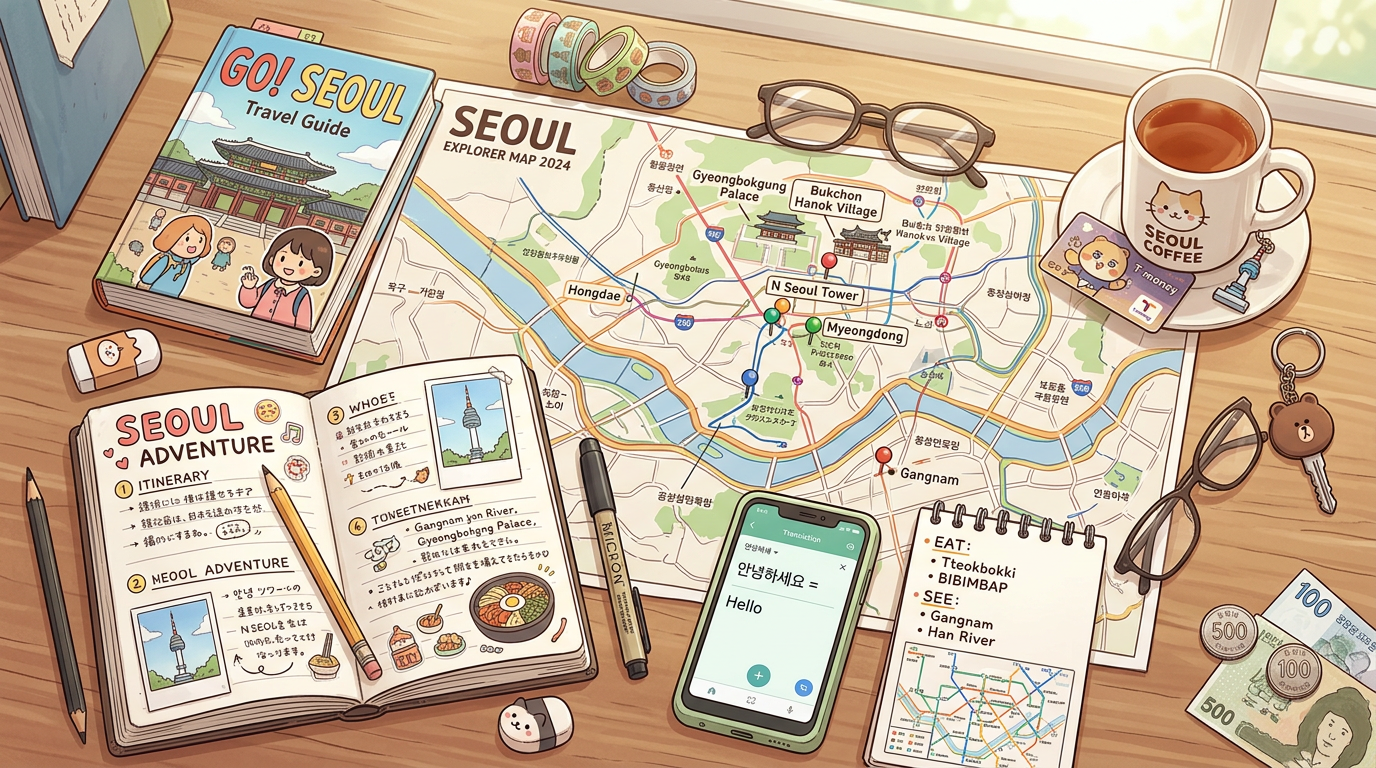
ㅁPlanning a Seoul trip is not only about finding famous restaurants and Instagram locations. You also need to decide how much cash to carry, which transportation card to buy, whether an attraction pass is worth the price and where tourist tax refunds can reduce your shopping bill.
This guide uses a planning exchange rate of ₩1,460 to US$1, based on mid-market rates checked on July 26, 2026. Therefore, ₩10,000 is approximately US$6.85, ₩50,000 is about US$34.25, and ₩100,000 is about US$68.49. Your bank, credit-card company, ATM or currency-exchange booth may use a different rate and add a fee.
Quick answer: A traveler who uses public transportation, eats mostly casual Korean food and chooses one paid attraction per day can budget roughly ₩70,000–₩150,000 per day, or US$47.95–US$102.74, excluding flights, accommodation and major shopping. A K-beauty, K-pop or theme-park day can cost considerably more.
📋 Table of Contents
- How Much Does a Trip to Seoul Cost in 2026?
- Best Way to Get from Incheon Airport to Seoul
- Seoul Transportation Pass Comparison
- Where to Stay in Seoul for First-Timers
- Cheap and Famous Korean Food in Seoul
- K-Beauty, K-Pop and Seoul Shopping Tips
- Seoul Attractions Worth Paying For and Free Options
- Seoul Budget Checklist, Conclusion and FAQs
1. How Much Does a Trip to Seoul Cost in 2026?
The most useful way to calculate a Seoul travel budget is to separate fixed costs from optional spending. Airport transportation, local transit and basic meals are relatively predictable. Hotels, flights, concerts, pop-up stores and shopping promotions are not.
The table below is an editorial planning model rather than an official citywide average. It is designed to help you build a realistic budget from current transport, restaurant and attraction prices.
| Daily expense | Budget day | Comfortable day | Shopping or theme-park day |
|---|---|---|---|
| Meals | ₩25,000–₩45,000 / $17.12–$30.82 | ₩50,000–₩90,000 / $34.25–$61.64 | ₩60,000–₩120,000 / $41.10–$82.19 |
| Local transportation | ₩5,000–₩10,000 / $3.42–$6.85 | ₩8,000–₩20,000 / $5.48–$13.70 | ₩10,000–₩30,000 / $6.85–$20.55 |
| Attractions | ₩0–₩30,000 / $0–$20.55 | ₩20,000–₩67,000 / $13.70–$45.89 | ₩55,000–₩130,000 / $37.67–$89.04 |
| Coffee and snacks | ₩5,000–₩15,000 / $3.42–$10.27 | ₩10,000–₩25,000 / $6.85–$17.12 | ₩15,000–₩35,000 / $10.27–$23.97 |
| Optional shopping | ₩0–₩30,000 | ₩30,000–₩150,000 | ₩150,000–₩500,000+ |
| Estimated total excluding hotel | ₩35,000–₩100,000 | ₩118,000–₩202,000 | ₩290,000+ |
You do not need to carry the full amount in cash. International cards are widely usable at department stores, convenience stores, major restaurants and branded shops, but small market stalls, transportation-card charging machines and individual vendors may still be easier to use with Korean won.
A practical approach is to carry ₩50,000–₩100,000, or about US$34–US$68, as backup cash and pay larger purchases by a card with no foreign-transaction fee. Always choose payment in Korean won when a card terminal offers “KRW or home currency.” Paying in your home currency can trigger dynamic currency conversion, whose exchange rate should be compared before approval.
2. Best Way to Get from Incheon Airport to Seoul on a Budget
Airport transportation is the first decision that affects your Seoul budget. The cheapest option is usually the AREX all-stop train. The fastest rail option is the AREX Express train, while an airport limousine bus may be more convenient when your hotel is far from a subway station.
Official Seoul tourism information lists the all-stop train at ₩4,150–₩4,750, taking about 60 minutes to Seoul Station. The non-stop express train is listed at ₩9,500 and takes approximately 40 minutes. Airport buses generally cost ₩5,000–₩15,000 and take around 60–80 minutes, depending on traffic and destination.
AREX Express vs All-Stop Train vs Airport Bus vs Taxi
| Airport transfer | Indicative price | Travel time | Best for |
| AREX all-stop train | ₩4,150–₩4,750 / $2.84–$3.25 | About 60 min to Seoul Station | Solo travelers, Hongdae, low budgets |
| AREX Express | ₩9,500 / $6.51 | About 40 min | Seoul Station, predictable journey |
| Airport limousine bus | ₩5,000–₩15,000 / $3.42–$10.27 | About 60–80 min | Hotels near a direct bus stop |
| Regular taxi to central Seoul | Often about ₩52,000–₩63,000 including toll / $35.62–$43.15 | About 70–100 min | Three or four travelers with luggage |
The taxi estimate combines the official destination examples with the separate ₩7,900 expressway toll. Traffic, nighttime surcharges and the exact destination can increase the amount. For example, the official guide estimates fares before the toll at approximately ₩44,000–₩48,500 to Insadong and ₩50,000–₩55,000 to the Dongdaemun area.
For one traveler, the all-stop train usually offers the best value. For three travelers, a ₩60,000 taxi is roughly ₩20,000 per person, so the convenience may justify the difference. For Hongdae, the all-stop train is especially practical because it serves Hongik University Station directly. For Myeongdong, compare the cost of transferring from Seoul Station with a direct airport bus to your hotel.
Do not buy an airport transfer only by looking at journey time. Count the walking distance, stairways, luggage size, arrival hour and the cost of the final subway or taxi connection.
3. Seoul Transportation Pass Comparison for Foreign Tourists
Seoul’s regular adult subway base fare is ₩1,550 by transportation card and ₩1,650 for a single-use ticket, based on the fare schedule effective from June 28, 2025. Distance surcharges can apply, and integrated transfers require travelers to tap correctly when entering and leaving buses or subway services.
Tourists generally choose among a standard T-money card, a short-term Climate Card or the Discover Seoul Pass.
T-Money vs Climate Card vs Discover Seoul Pass
| Product | Current cost | What it covers | Best use case |
| T-money | Pay per ride; adult subway base fare ₩1,550 / $1.06 | Subway, buses and other compatible payments after top-up | Light transit use and trips outside central Seoul |
| Climate Card 1-day | ₩5,000 + ₩3,000 physical card / about $5.48 total initially | Unlimited eligible Seoul subway and bus rides for the charged day | Several separate journeys in one day |
| Climate Card 3-day | ₩10,000 + card / about $8.90 initially | Unlimited eligible transport for three days | City-focused short breaks |
| Climate Card 5-day | ₩15,000 + card / about $12.33 initially | Unlimited eligible transport for five days | Standard five-day Seoul itinerary |
| Climate Card 7-day | ₩20,000 + card / about $15.75 initially | Unlimited eligible transport for seven days | Longer city stays |
| Discover Seoul Pass 72-hour | ₩90,000 / $61.64 | Included attractions, discounts, eSIM benefit and transit-card function after top-up | Intensive sightseeing |
| Discover Seoul Pass 120-hour | ₩130,000 / $89.04 | Longer attraction period and benefits | Five-day attraction-heavy trip |
| Discover Seoul Pass Pick 3 | ₩49,000 / $33.56 | Three eligible attractions | Selective sightseeing |
| Pick 3 Theme Park | ₩70,000 / $47.95 | Three eligible attractions including a theme park | Theme-park visitors |
The Climate Card’s short-term prices are officially listed at ₩5,000 for one day, ₩8,000 for two days, ₩10,000 for three days, ₩15,000 for five days and ₩20,000 for seven days. A physical card costs an additional ₩3,000. International credit and debit cards can be used to purchase and recharge short-term passes at supported machines.
There is an important airport limitation. The Climate Card can be used on the AREX section between Gimpo Airport and Seoul Station. It may also be used to exit at Incheon Airport after boarding within the eligible area, but it cannot be used to begin a trip at Incheon Airport Terminal 1 or Terminal 2.
The 30-day prepaid Climate Card was scheduled to stop accepting new recharges after July 31, 2026, while short-term passes remain available. Short-term tourists should therefore focus on the one-, two-, three-, five- and seven-day options rather than older articles describing only the monthly product.
The Discover Seoul Pass is not simply a transportation pass. Its value comes from included attractions. The official site lists a 72-hour pass at ₩90,000, a 120-hour pass at ₩130,000, a basic Pick 3 pass at ₩49,000 and a theme-park Pick 3 pass at ₩70,000. The physical version can work as a prepaid transit card after money is added, but ordinary subway and bus fares are not automatically unlimited.
Decision rule: Choose T-money when you expect only one or two paid journeys per day or plan to travel outside the Climate Card service area. Choose a short-term Climate Card when you expect three or more separate journeys most days within Seoul. Choose the Discover Seoul Pass only after listing the exact paid attractions you can realistically visit during its timed validity.
4. Where to Stay in Seoul for First-Time Visitors Without Overspending
The cheapest hotel is not always the cheapest trip. A room that saves ₩20,000 per night may add airport-transfer costs, daily subway journeys and an hour of travel every day.
Myeongdong, Hongdae, Jongno, Gangnam and Jamsil serve different itineraries. Compare hotels for the same dates, room type, cancellation policy, taxes and breakfast rather than relying on a generic neighborhood average.
Myeongdong vs Hongdae vs Gangnam Travel Cost Comparison
Myeongdong is efficient for first-time visitors who prioritize Gyeongbokgung Palace, Namsan, Namdaemun, Insadong, department stores and K-beauty shopping. Staying within walking distance of two or three planned destinations can reduce daily transport spending. The disadvantage is that Myeongdong makes impulse shopping extremely easy.
Hongdae is practical for travelers arriving by the AREX all-stop train and visitors interested in youth fashion, live music, dance culture, cafés and nightlife. It can be cheaper operationally when your itinerary focuses on western Seoul, but repeated journeys to Jamsil or Gangnam add time.
Gangnam and COEX work well for business travelers, K-pop shoppers, Starfield Library visitors and travelers combining COEX with Jamsil, Lotte World or Seoul Sky. The area is less efficient for a palace-centered itinerary in northern Seoul.
Jongno and Euljiro are strong alternatives for travelers who want Gyeongbokgung, Changdeokgung, Insadong, Ikseon-dong, Gwangjang Market and Cheonggyecheon within a relatively compact area. Travelers can build several low-cost walking days from this base.
Before booking, calculate the total of the room price, airport connection, breakfast, luggage storage and estimated daily transfers. Also check whether “pay at property” means your card will be charged in Korean won and whether the quoted amount includes all taxes.
5. Cheap and Famous Korean Food in Seoul with Prices
Food is one of the easiest categories to control. You can combine a convenience-store breakfast, a famous lunch and a shared dinner without feeling that you are sacrificing the Seoul experience.
As a planning guide, allow ₩3,000–₩8,000, or US$2.05–US$5.48, for a market snack; ₩9,000–₩15,000, or US$6.16–US$10.27, for a casual meal; and ₩20,000–₩40,000 per person, or US$13.70–US$27.40, for a more substantial barbecue, chicken or specialty dinner. Actual prices depend on the restaurant, portion size and whether dishes must be ordered for two people.
Korean foods worth budgeting for include tteokbokki, gimbap, hotteok, mandu, bibimbap, kalguksu, samgyetang, Korean fried chicken, grilled pork belly, naengmyeon and convenience-store snacks.
Gwangjang Market vs Myeongdong Kyoja vs Tosokchon Prices
| Place and dish | Checked price | Approximate USD | Budget assessment |
| Gwangjang Market mayak gimbap | ₩3,000–₩5,000 | $2.05–$3.42 | Good snack or light meal |
| Myeongdong Kyoja kalguksu | ₩12,000 | $8.22 | Strong-value famous lunch |
| Myeongdong Kyoja mandu | ₩13,000 | $8.90 | Best shared by two |
| Kalguksu and mandu combination | ₩25,000 | $17.12 | About $8.56 per person for two |
| Tosokchon standard samgyetang | Reported at ₩20,000 | $13.70 | Higher-priced specialty meal |
| Mid-tier chain iced Americano example | ₩3,200 | $2.19 | Low-cost coffee break |
| Convenience-store bottled water example | ₩1,100 | $0.75 | Useful daily reference |
Gwangjang Market is ideal for tasting several foods, but prices and payment methods differ by stall. A current market directory lists small mayak gimbap portions at approximately ₩3,000–₩5,000. Bring some cash and confirm the price before ordering multiple plates.
At Myeongdong Kyoja’s main branch, a 2026 menu check lists kalguksu at ₩12,000 and a ten-piece mandu plate at ₩13,000. One noodle bowl and one dumpling plate cost ₩25,000, making it a practical meal for two travelers who want to try both dishes.
Tosokchon near Gyeongbokgung is a destination restaurant rather than the cheapest samgyetang option. A 2026 menu report lists the standard dish at ₩20,000. Because this is not an official restaurant price page, confirm the menu at the entrance before ordering.
A Reuters Seoul cost guide reported an iced Americano at Ediya Coffee at ₩3,200 and a bottle of Jeju Samdasoo at a CU convenience store at ₩1,100. These examples are useful budget anchors, although branch and promotional prices can change.
To reduce costs, eat famous restaurant meals at lunch, share large dumpling or chicken dishes and avoid ordering a separate drink at every café. In markets, verify whether one plate is intended for one person or for sharing.
6. K-Beauty, K-Pop and Seoul Shopping Tax Refund Guide
Shopping can exceed your food and transportation budget in a single afternoon. Set separate limits for skincare, albums, fashion and souvenirs instead of using one large shopping allowance.
Best K-Beauty Shopping in Myeongdong for Foreigners
Olive Young Myeongdong Global Town is located at 53 Myeongdong-gil, Jung-gu and is designed for international shoppers. The store provides foreign-language assistance and immediate tax-refund services for eligible in-store purchases. Its global service lounge also handles applicable refund procedures.
Current Olive Young product pages illustrate why travelers should compare the list price, promotional price, package size and gift set rather than assuming every sale label offers the best value.
| Actual product example | List price | Checked promotional price | Approximate USD sale price |
| Torriden Dive-In Watery Fit Sun Serum 50 ml | ₩25,000 | ₩20,000 | $13.70 |
| Laneige Lip Sleeping Mask 20 g | ₩22,000 | From ₩17,600 | $12.05 |
| Torriden Solid-In Ceramide All Day Essence 100 ml | ₩26,000 | ₩18,200 | $12.47 |
These online promotional prices were visible when checked but may not match every physical branch or the date of your visit. Compare the price per milliliter, included miniatures and whether the package exceeds your airline’s cabin-liquid allowance.
Foreign tourists can generally request a domestic tax refund when an eligible purchase at a participating store is at least ₩15,000 and the goods are taken out of Korea within the required period. The Seoul tourism guide states that immediate-refund purchases must be under ₩1,000,000 per transaction and total immediate-refund purchases must remain under ₩5,000,000 for the trip. Keep your passport, refund documents, receipts and purchased goods available for inspection.
Do not spend more merely to cross a tax-refund threshold. The refund is only valuable when you already intended to buy the product. Check whether the price shown at checkout is tax-inclusive, immediately reduced or subject to a later airport refund.
Where to Buy Official K-Pop Albums in Seoul
Ktown4u COEX is a K-pop complex in COEX Artium at 513 Yeongdong-daero, Gangnam-gu, with an offline shop, café, academy and rotating pop-up activities. Ktown4u also operates an Insadong location at 3F, 49 Insadong-gil, Jongno-gu, which is easier to combine with a palace and traditional-neighborhood itinerary.
Official catalog examples show that compact, platform or QR-based album versions frequently sit around ₩14,000–₩16,500, or approximately US$9.59–US$11.30. Standard boxed versions may cost around ₩20,000–₩33,000, while multi-version or collector sets can reach ₩55,000, ₩77,000 or more.
Before buying an album, compare the version name, physical CD or digital format, photocard configuration, random inclusions, outer-box condition and return policy. A cheap platform version may not include a standard CD, while buying every version for different photocards can multiply the final cost.
For Korean fashion, Musinsa Standard Seongsu offers the brand’s basic casualwear near the wider Seongsu shopping and café district. The official store locator should be checked immediately before visiting because Seoul flagships and pop-ups can change locations or operating details.
Budget souvenir shoppers can compare Daiso, traditional markets and museum stores. One reported Daiso example priced metal chopsticks at ₩2,000, or approximately US$1.37. Museum stores can cost more but may offer better cultural context and design quality.
7. Seoul Attractions Worth Paying For and the Best Free Things to Do
Seoul has enough free neighborhoods, parks and cultural spaces to prevent attraction tickets from dominating your budget. The key is to pay for experiences that are meaningfully different from what you can see for free.
| Attraction | Adult price | Approximate USD | Value note |
| Gyeongbokgung Palace | ₩3,000 | $2.05 | Excellent low-cost cultural site |
| N Seoul Tower Observatory | ₩29,000 | $19.86 | Central skyline and night-view option |
| Seoul Sky | ₩33,000 | $22.60 | Higher modern observatory in Jamsil |
| Lotte World full-day comprehensive pass | ₩67,000 | $45.89 | Full theme-park day |
| Lotte World After 4 pass | ₩55,000 | $37.67 | Better for late arrival |
| Discover Seoul Pass 72-hour | ₩90,000 | $61.64 | Potential value for intensive sightseeing |
The official Royal Palaces and Tombs Center lists Gyeongbokgung admission at ₩3,000 for an adult foreign visitor. Visitors wearing qualifying traditional or modernized hanbok can receive free admission when the required upper and lower garments are worn correctly.
N Seoul Tower lists adult observatory admission at ₩29,000, while Seoul Sky lists its general adult admission at ₩33,000. Paying for both is unnecessary for many travelers. Choose N Seoul Tower for the Namsan setting and central-city atmosphere; choose Seoul Sky for a high-rise Jamsil experience and a Lotte World itinerary.
Lotte World’s official ticket page lists a full-day adult comprehensive pass at ₩67,000 and an After 4 pass at ₩55,000. The comprehensive ticket includes Lotte World Adventure and the Folk Museum, while separately paid facilities can remain excluded.
A simple Discover Seoul Pass break-even test is to add the normal prices of attractions you will actually enter. Lotte World at ₩67,000 plus N Seoul Tower at ₩29,000 totals ₩96,000, already above the ₩90,000 price of the 72-hour pass. However, attraction partnerships, included ticket types and admission conditions can change, so verify both attractions in the pass application before purchase.
Free or mostly free Seoul experiences include walking Cheonggyecheon, exploring the public areas of the Han River parks, visiting Starfield Library at COEX, walking around Hongdae and Seongsu, hiking Namsan instead of buying a cable-car ticket and exploring the lanes around Insadong and Ikseon-dong. Bukchon Hanok Village is a residential neighborhood, so visit quietly, follow restricted-hour signs and avoid blocking residents’ entrances.
A Realistic Five-Day Seoul Budget in KRW and USD
The following example excludes flights and accommodation because those prices depend heavily on the departure country, season, booking date and room conditions.
| Five-day expense | Calculation | Total |
| AREX all-stop airport arrival | One trip | ₩4,750 / $3.25 |
| Climate Card physical card | One card | ₩3,000 / $2.05 |
| Five-day Climate Card | One pass | ₩15,000 / $10.27 |
| Meals | ₩45,000 × 5 days | ₩225,000 / $154.11 |
| Coffee and snacks | ₩10,000 × 5 days | ₩50,000 / $34.25 |
| Gyeongbokgung | One admission | ₩3,000 / $2.05 |
| N Seoul Tower | One admission | ₩29,000 / $19.86 |
| Seoul Sky | One admission | ₩33,000 / $22.60 |
| K-beauty, K-pop and souvenirs | Fixed allowance | ₩100,000 / $68.49 |
| Emergency buffer | Fixed allowance | ₩20,000 / $13.70 |
| Five-day local total | ₩482,750 / about $330.65 |
This sample gives you three paid attractions, a moderate food allowance, unlimited eligible city transport and ₩100,000 for shopping. You can reduce it by skipping one observatory, replacing paid attractions with free neighborhoods or lowering the shopping allowance. Adding Lotte World would increase the total by as much as ₩67,000, while choosing a Discover Seoul Pass could reorganize the attraction portion of the budget.
8. Seoul Budget Checklist, Conclusion and FAQ
Money-saving checklist
- Check the USD/KRW rate shortly before departure and use one consistent planning rate.
- Carry a small cash reserve rather than exchanging your entire budget at the airport.
- Compare the hotel’s total price, airport connection and daily transport—not only the room rate.
- Count realistic paid journeys before choosing T-money or a Climate Card.
- List exact attractions before buying the Discover Seoul Pass.
- Keep your passport and receipts available for eligible tourist tax refunds.
- Compare K-beauty package size and unit price, not only the discount percentage.
- Check K-pop album versions and inclusions before buying multiple copies.
- Leave a 10%–15% budget buffer for weather changes, late taxis or impulse purchases.
Conclusion
Seoul offers excellent value when you match each product to your itinerary. T-money is usually the flexible choice for light transport use. A short-term Climate Card is attractive for travelers making several journeys per day inside the supported area. The Discover Seoul Pass can provide strong value when your schedule includes Lotte World, an observatory and additional eligible attractions, but it is unnecessary for a mostly free walking itinerary.
Food costs remain manageable when you combine markets, noodle restaurants, convenience stores and one specialty dinner. Shopping is the category most likely to break the budget, so set separate limits for K-beauty, K-pop, fashion and souvenirs.
The best financial decision is not always the cheapest individual ticket. It is the option that reduces unnecessary transfers, waiting time, duplicate attractions and purchases you did not originally plan to make.
Frequently Asked Questions
1. How much money should I budget for five days in Seoul?
The sample in this guide totals approximately ₩482,750, or US$330.65, excluding flights and accommodation. A traveler focused on free attractions may spend less, while Lotte World, nightlife and extensive shopping can push the total significantly higher.
2. Is T-money or the Climate Card better for tourists?
T-money is better for occasional travel, flexible routes and journeys outside the Climate Card area. A short-term Climate Card can be better when you make several separate eligible trips per day within Seoul.
3. Should I exchange all my money at Incheon Airport?
It is generally more flexible to exchange or withdraw only enough for transportation and immediate expenses, then compare the rate and fees offered by your bank, ATM or a licensed city exchange counter. Keep receipts for larger exchanges.
4. How does the Korea tourist tax refund work?
Eligible foreign visitors can request a refund at participating stores when the qualifying purchase is at least ₩15,000. Immediate refunds and later downtown or airport refunds have different procedures and limits, so keep your passport, refund documents and goods available.
5. Is the Discover Seoul Pass worth it?
It can be worth it when the normal prices of your confirmed eligible attractions exceed the pass price. It is usually poor value when your itinerary mainly includes markets, neighborhoods, parks, cafés and low-cost palace admission.
Price check date: July 26, 2026. USD figures use a rounded planning exchange rate of ₩1,460 per US$1. Prices, promotions, operating hours, attraction partnerships and foreign-exchange rates can change. Confirm major purchases on the official website before travel.
Key References and Official Sources
- USD/KRW mid-market exchange-rate data used for the currency conversions in this article. Wise USD to KRW Exchange Rate History
- Official Seoul Metropolitan Government information on subway fares, distance-based charges and transfer rules. Seoul Subway Fares and Transportation Information
- Official Seoul Metropolitan Government information on Climate Card prices, eligible transportation services, service areas and airport-use restrictions. Seoul Climate Card Guide
- Official Seoul tourism information comparing AREX trains, airport limousine buses and taxis between Incheon International Airport and central Seoul. Transportation from Incheon Airport to Seoul
- Official Discover Seoul Pass information, including current pass prices, attraction benefits, usage periods and transportation-card functions. Discover Seoul Pass Official Website
- Official Cultural Heritage Administration information on Gyeongbokgung Palace admission fees and free admission for visitors wearing qualifying hanbok. Gyeongbokgung Palace Visitor Information
- Official N Seoul Tower information on observatory admission prices and visitor facilities. N Seoul Tower Admission Information
- Official Seoul Sky information on admission tickets, visitor facilities and operating conditions. Seoul Sky Official Website
- Official Lotte World Adventure information on full-day and After 4 admission-ticket prices. Lotte World Ticket Prices
- Official Seoul tourism guidance on tax-refund eligibility, immediate refunds, purchase thresholds and airport refund procedures for foreign visitors. Seoul Tourist Tax Refund Guide
- Official information for Olive Young Myeongdong Global Town, including its location, foreign-language services and tax-refund support. Olive Young Myeongdong Global Town
- Official Olive Young product pages used to compare selected K-beauty product prices, package sizes and promotional offers. Olive Young Korea Online Store
- Official Ktown4u information on its COEX and Insadong stores, K-pop album products and store facilities. Ktown4u Store Information
- Official and public tourism information on Gwangjang Market, including its location, food stalls and visitor guidance. Gwangjang Market Visitor Information
- Restaurant menu information used as a price reference for Myeongdong Kyoja’s kalguksu and mandu. Prices may change and should be confirmed at the restaurant. Myeongdong Kyoja Menu Reference
- Current menu information used as a secondary reference for Tosokchon samgyetang. Because this is not the restaurant’s official price page, visitors should confirm the posted menu before ordering. Tosokchon Samgyetang Price Reference
- Reuters’ practical Seoul cost guide, used for selected convenience-store, coffee and low-cost souvenir price examples. Reuters Seoul City Guide

댓글 남기기