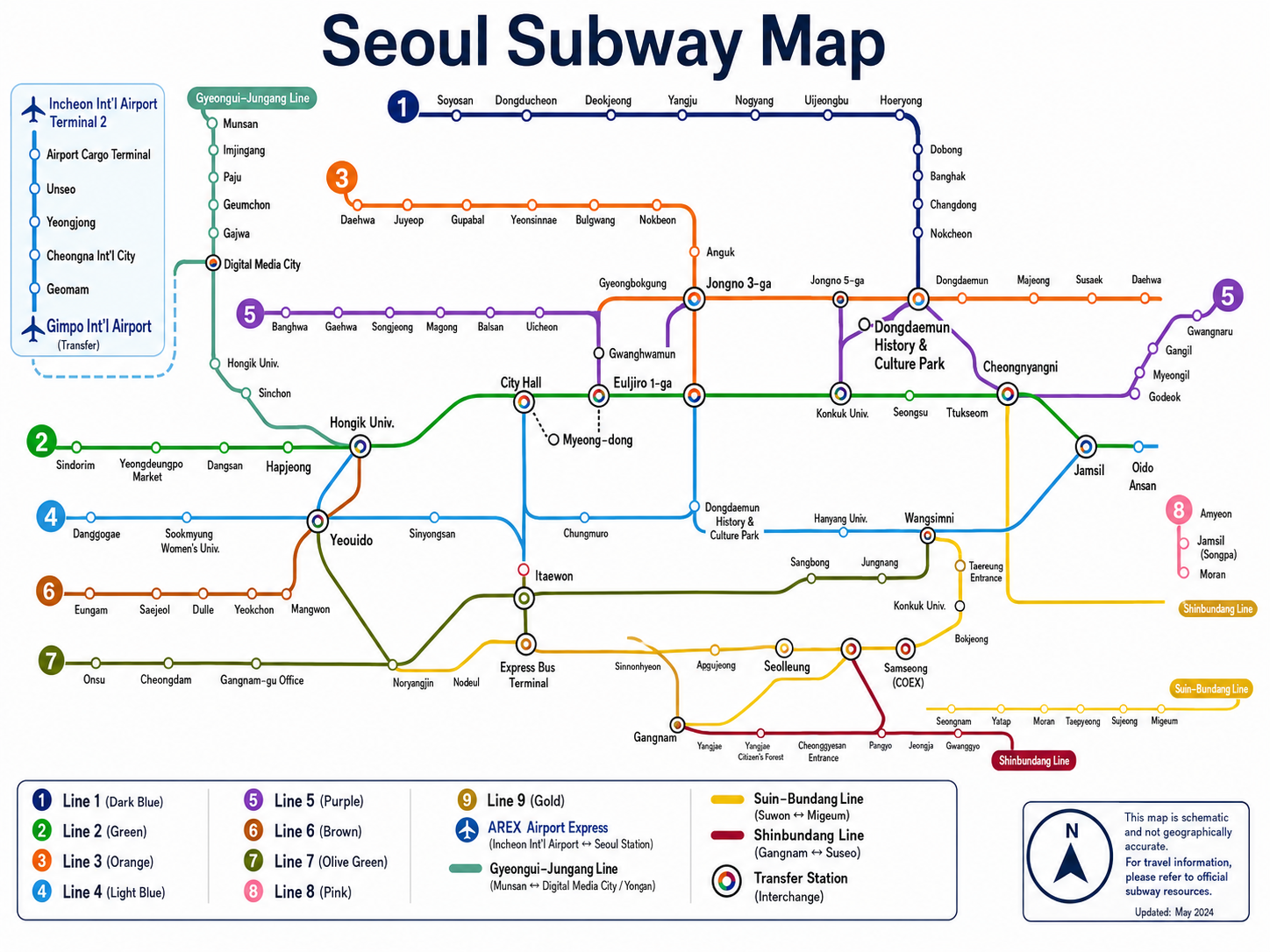
Seoul’s transportation system connects palaces, markets, K-pop stores, K-beauty districts, food streets, shopping malls and nightlife areas without requiring a rental car. The difficult part is not finding transportation. It is choosing the right ticket, card or route for your itinerary.
Should you buy a T-money card or a Climate Card? Is the AREX Express worth paying more for? Can you use a foreign credit card at a subway ticket machine? What should you do when the subway closes after a concert or a late dinner in Hongdae?
This guide answers those questions with current fares in Korean won and US dollars. Prices were checked on July 26, 2026, and converted at a planning rate of US$1≈₩1,459. Your bank, card issuer or ATM may apply a different exchange rate and addit
Quick answer: T-money is usually best for flexible or light transportation use. A short-term Climate Card can offer better value when you make several eligible subway and bus journeys each day inside Seoul. Airport trains, airport buses and taxis should be compared separately because the Climate Card cannot be used to begin a journey at Incheon Airport.
📋 Table of Contents
- How to Use Seoul Public Transportation
- T-Money vs Climate Card for Tourists
- How to Use the Seoul Subway Without Getting Lost
- How to Ride Seoul Buses and Get Free Transfers
- Best Way from Incheon Airport to Seoul
- Seoul Late-Night Transportation After Midnight
- How to Reach K-Pop, K-Beauty and K-Food Spots
- Seoul Public Transportation Cost
1. How to Use Seoul Public Transportation for Foreign Tourists
Seoul’s core transportation network includes subways, city buses, village buses, night buses, airport trains, airport limousine buses, taxis, public bicycles and the Hangang Bus. Most first-time visitors can complete almost every sightseeing itinerary by combining the subway with short walks.
The subway is generally the easiest option when you need predictable travel times and English-language station information. Buses are useful for routes that require a long walk from a subway station, but they require more attention to direction, stop names and the correct time to press the stop button.
| Transportation option | Typical adult price | Approximate USD | Best for |
|---|---|---|---|
| Seoul subway with transit card | From ₩1,550 | From $1.06 | Most sightseeing journeys |
| Single-use subway ticket | From ₩1,650 | From $1.13 | Travelers without a transit card |
| Blue or green city bus | ₩1,500 | $1.03 | Cross-city and neighborhood travel |
| Village bus | ₩1,200 | $0.82 | Short local connections |
| Red metropolitan bus | ₩3,000 | $2.06 | Longer suburban journeys |
| Owl night bus | ₩2,500 | $1.71 | Travel after ordinary services end |
| Regular taxi | From ₩4,800 | From $3.29 | Luggage, groups and late nights |
| Seoul Public Bike | From ₩1,000 | From $0.69 | Han River and park areas |
| Hangang Bus | ₩3,000 | $2.06 | Scenic river travel |
The current adult Seoul subway base fare is ₩1,550 with a transportation card and ₩1,650 with a single-use ticket. Bus fares vary by type: ordinary blue and green buses cost ₩1,500, village buses cost ₩1,200, red metropolitan buses cost ₩3,000 and Owl night buses cost ₩2,500. Distance charges may be added to longer integrate
A transit card is more than a convenient payment method. It enables integrated subway and bus transfers when you follow the tap-in and tap-out rules. It also prevents the need to buy a separate ticket before every journey.
Foreign visitors should install at least one Korean navigation application before departure. Naver Map is particularly useful for comparing subway, bus, walking and taxi routes. Subway Korea can help with railway maps and transfer planning, while Papago is useful when signs or driver communication require translation. Actual last-train and bus arrival times should still be checked on the day
2. T-Money vs Climate Card for Tourists: Which Seoul Transportation Pass Is Best?
T-money and the Climate Card are not identical products.
T-money is a rechargeable stored-value card. Each fare is deducted from the balance when you travel. It can be used on compatible subways, buses and taxis and at participating convenience stores.
The short-term Climate Card is a time-based unlimited pass for eligible Seoul transportation. It is sold in one-, two-, three-, five- and seven-day versions. Its main benefit is cost certainty, but its service area and included transportation modes are more limited than many visit
T-Money vs Climate Card vs Mpass vs Discover Seoul Pass
| Product | Price | Main benefit | Important limitation | Best traveler |
| T-money | Card about ₩3,000 plus balance | Flexible pay-per-ride travel | Requires sufficient stored balance | Light users and flexible itineraries |
| Climate Card 1-day | ₩5,000 plus ₩3,000 card | Unlimited eligible travel for one day | First-day cost includes card purchase | Intensive one-day sightseeing |
| Climate Card 3-day | ₩10,000 plus card | Unlimited eligible travel for three days | Incheon Airport boarding excluded | Seoul-focused weekend trip |
| Climate Card 5-day | ₩15,000 plus card | Unlimited eligible travel for five days | Some rail sections and transport modes excluded | Standard five-day city trip |
| Climate Card 7-day | ₩20,000 plus card | Unlimited eligible travel for seven days | No advance activation for short-term pass | Longer Seoul stay |
| Mpass 1-day | ₩15,000 including deposit | Up to 20 eligible rides a day | Cash purchase and limited issue location | Travelers needing broader metropolitan coverage |
| Discover Seoul Pass 72-hour | ₩90,000 | Attractions plus selected benefits | Not an unlimited subway and bus pass | Attraction-heavy itinerary |
The official short-term Climate Card prices are ₩5,000 for one day, ₩8,000 for two days, ₩10,000 for three days, ₩15,000 for five days and ₩20,000 for seven days. A reusable physical card costs an additional ₩3,000. Short-term validity begins when the pass is charged, so it should not be activated days before you plan
The Climate Card covers eligible Seoul subway sections, Seoul-licensed city and village buses and certain other services. Short-term tourist passes do not include Seoul Public Bike or the Hangang Bus. The card can be used on the AREX section between Gimpo Airport and Seoul Station, but it cannot be used to board at Incheon Airport Terminal 1 or
A simple break-even calculation shows why the Climate Card can be attractive. Four subway rides at the ₩1,550 base fare total ₩6,200, which is more than a ₩5,000 one-day pass. However, a first-time purchaser must also pay ₩3,000 for the physical card. The one-day option therefore makes more sense when you will reuse the card later or make several long or mixed subway-and-bus journeys.
The Mpass provides up to 20 eligible rides a day on metropolitan subways, the AREX all-stop train and selected Seoul buses. Official prices are ₩15,000 for one day, ₩23,000 for two days, ₩30,500 for three days, ₩47,500 for five days and ₩64,500 for seven days. The price includes a ₩5,000 deposit, of which ₩4,500 can be returned after a ₩500 service fee. It is less convenient for many short-term tourists because it is issued for cash at a limited location, including Tmoney Town at Seoul Station during specified busi
The Discover Seoul Pass should be treated as an attraction pass, not as an unlimited transportation pass. The physical card can function as a T-money card after separate balance is added, but ordinary subway and bus fares are not automatically included. Current prices include ₩90,000 for 72 hours, ₩130,000 for 120 hours, ₩49,000 for a Pick 3 Basic pass and ₩70,000 for a Pick 3 Theme
Where to Buy and Recharge a T-Money Card in Seoul
T-money cards are available at many convenience stores, subway stations and designated tourist information locations. The card itself generally costs around ₩3,000, and the amount you plan to spend must be added separately. The remaining balance does not expire simply because your trip ends. Small balances can be refunded at participating convenience stores, usually after a s
Traditional T-money recharging is often cash-based, so carry several ₩10,000 notes for the first top-up. Do not assume every subway machine or convenience-store terminal accepts the same foreign card.
Since March 17, 2026, international credit and debit cards have been accepted at hundreds of designated machines on Seoul Subway Lines 1–8 for short-term Climate Card purchases and single-journey tickets. Seoul states that an average service fee of approximately 3.7% may be added to foreign-card tr
Choose T-money when you expect only one or two journeys on some days, plan to travel outside the Climate Card coverage area or want one stored-value card for transportation and small purchases. Choose the Climate Card when your itinerary includes several daily journeys within Seoul and you prefer not to calculate the remaining balance.
3. How to Use the Seoul Subway Without Getting Lost
Seoul subway stations use line numbers, colors, station names and station numbers. This makes the network easier to navigate than relying only on Korean place names. Nevertheless, the same station may have several exits located hundreds of meters apart.
Always check the exit number before leaving the station. Choosing the wrong exit at large stations such as Seoul Station, Gangnam, Express Bus Terminal, Jamsil or Dongdaemun History & Culture Park can add a long underground walk.
The adult base fare is ₩1,550 with a transit card for the initial distance. Longer journeys add distance-based charges. A single-use ticket begins at ₩1,650 and requires a separate refundable deposit of ₩500. Return the ticket at a deposit-refund machine afte
To enter, tap the card on the gate reader and wait for confirmation. Tap again when leaving. When transferring between eligible subway and bus services, use the same card throughout the complete journey.
Integrated transfers can include up to five boardings, which means up to four transfers. The next vehicle must generally be boarded within 30 minutes of tapping out, or within 60 minutes during the late-evening and early-morning trans
Most subway services operate from approximately 5:30 a.m. until around midnight, but the exact first and last train differs by station, direction, weekday and line. Check the last complete route rather than only the departure time from your first station. A final train may terminate before your intended d
Travelers carrying suitcases, using wheelchairs or traveling with strollers should check elevator locations before arriving. Many stations have elevators and accessible gates, but the elevator may be located at only one end of a long platform or near an exit that is not closest to your d
Best Seoul Subway Lines for Tourist Attractions
Line 1 is useful for Seoul Station, Jongno and Gwangjang Market. Gwangjang Market is close to Jongno 5-ga Station Exit 8 and is a convenient stop for bindaetteok, mayak gimbap, noodles and traditional marke
Line 2 connects several of the city’s most popular modern districts. Hongik University Station serves Hongdae nightlife, street performances, cafés and independent fashion. Seongsu Station serves Seoul’s café, pop-up and lifestyle-shopping district. Gangnam Station is useful for restaurants and nightlife, Samseong serves COEX, and Jamsil connects directly to Lotte World and the surrounding shopping complex.
Line 3 is particularly useful for cultural Seoul. Gyeongbokgung Station provides access to Gyeongbokgung Palace and the western side of the palace area. Anguk Station is useful for Insadong, Ikseon-dong, Bukchon and Changdeokgung. Farther south, Sinsa serves Garosu-gil, and Express Bus Terminal connects to a major shopping complex and Lin
Line 4 is one of the easiest lines for first-time visitors staying in Myeongdong. Myeongdong Station serves shopping streets, restaurants, Namsan access and the Olive Young Myeongdong Global Town area. The store can be reached from Myeongdong Station Exit 8 or Euljiro 1-ga Stat
Line 5 is useful for Gwanghwamun, Yeouido and Gimpo Airport. Gongdeok Station connects Lines 5 and 6, the Gyeongui–Jungang Line and AREX. This makes it a practical hotel area for airport access, and nearby Gongdeok Market is known for jokbal and Korea
Line 9 is useful for Gimpo Airport, Yeouido, Express Bus Terminal and Bongeunsa near COEX. Express services skip some stations, so confirm whether your destination is an express stop before boarding.
4. How to Ride Seoul Buses and Get Free Transfers
Seoul buses are useful when a destination sits between subway stations, when a hill makes walking difficult or when a direct surface route is more convenient than multiple subway transfers.
Enter through the front door unless the vehicle indicates otherwise. Tap your card on the reader, move inside and watch the route display or navigation application. Press the stop button before your destination and tap again when leaving through the rear door.
Tapping off is essential. It calculates any distance charge and starts the transfer period. Forgetting to tap may result in an incomplete fare calculation and can prevent a discounted transfer.
Seoul Bus Colors, Night Buses and Transfer Rules
Blue buses operate major trunk routes across longer distances within Seoul. Green buses generally connect neighborhoods and subway stations. Yellow buses serve circulation or selected local routes. Red buses are longer-distance metropolitan services that connect Seoul with surroun
| Bus type | Adult transit-card fare | Approximate USD |
| Blue or green bus | ₩1,500 | $1.03 |
| Yellow or differential-fare bus | ₩1,400 | $0.96 |
| Red metropolitan bus | ₩3,000 | $2.06 |
| Village bus | ₩1,200 | $0.82 |
| Owl night bus | ₩2,500 | $1.71 |
The integrated fare system permits up to four transfers when the same card is used correctly. The next service must normally be boarded within 30 minutes, extended to 60 minutes between 9 p.m. and 7 a.m. Boarding another vehicle on the same route is not necessarily treated as a discounte
Some Seoul buses operate without accepting cash, so a transportation card should be considered essential rather than optional. Keep enough balance for the final journey of the day, especially before leaving a subway area for a neighborhood served mainl
Bus navigation applications may display the number of stops remaining and the expected arrival time. Nevertheless, traffic can make a bus journey less predictable than the subway. During weekday rush hours, choose the subway for time-sensitive reservations.
Best English Apps for Real-Time Seoul Bus Information
Real-time bus information is especially important in Seoul because arrival times can change with traffic, road construction, demonstrations, weather and temporary route diversions. For most foreign visitors, NAVER Map is the best all-around transportation app, while KakaoBus is useful when you want a faster, bus-focused arrival screen.
The apps below provide English-language support and can help you check nearby stops, bus numbers, estimated arrival times, route directions and boarding or exit notifications.
| App or service | Best feature | English support | Recommended use |
|---|---|---|---|
| NAVER Map | Complete bus, subway and walking directions | English maps and navigation | Best overall app for foreign tourists |
| KakaoBus | Real-time bus arrival information and saved stops | English and Korean | Best for quickly checking when a bus will arrive |
| KakaoMap | Public transportation routes, bus stops and local places | English and Korean | Useful alternative for route and neighborhood searches |
| Seoul TOPIS | Official Seoul traffic and bus information | English website available | Best official backup for traffic conditions and bus-system information |
NAVER Map: Best Overall Seoul Bus App for Foreign Tourists
NAVER Map is the most practical first download for visitors who need one application for buses, subways, walking routes and destination searches. Its transit function provides public transportation directions, estimated departure and arrival times and notifications for when to board or leave.
The app supports English-language maps and navigation. You can search for a hotel, restaurant, palace, shopping mall or attraction in English and compare bus-only routes with subway-and-bus combinations. It is particularly useful when traveling to places such as Bukchon, Namsan, Banpo Hangang Park or hillside neighborhoods where the final bus connection may save a long walk.
Recommended settings after installation:
- Change the application language to English.
- Allow location access while using the app.
- Enable transit notifications.
- Save your hotel as a favorite.
- Save the nearest bus stop in both travel directions.
Bus stops on opposite sides of the same road may have similar English names but different stop identification numbers. Check the direction arrow, the next major stop and the bus route before boarding.
KakaoBus: Best App for Live Seoul Bus Arrival Times
KakaoBus is a dedicated bus and subway information app operated by Kakao Mobility. It provides real-time arrival information for Seoul, Incheon, Gyeonggi Province and other major Korean cities.
The app allows travelers to search by bus number or stop, save frequently used stops and receive boarding or exit notifications. Its interface supports English and Korean, making it one of the easiest options when you already know which bus route you need and only want to check how many minutes remain before arrival.
KakaoBus is particularly useful in the following situations:
- Checking whether the next bus is approaching or still several stops away
- Saving the bus stop closest to your hotel
- Monitoring a night bus after the subway has closed
- Receiving an alert before your destination
- Checking bus information outside central Seoul
Travelers should still compare the destination shown on the bus with the route displayed in the app. The same route number may serve stops in both directions, and boarding on the wrong side of a major road can create a lengthy detour.
KakaoMap: Best Alternative for Local Places and Bus Routes
KakaoMap combines public transportation directions with destination, restaurant and attraction searches. It provides real-time bus information, bus-stop searches, walking directions and route comparisons.
It is a useful alternative when a place name is difficult to find in another map application or when you want to inspect the surrounding streets before choosing a stop. Its Road View function can also help you recognize the correct side of the road, building entrance or bus-stop location before leaving your hotel.
NAVER Map and KakaoMap occasionally display slightly different suggested routes. When your trip involves an important reservation, airport transfer or last bus of the evening, compare both applications and choose the route with a reasonable transfer margin.
Seoul TOPIS: Official Bus and Traffic Information Backup
Seoul TOPIS is the city’s official Transport Operation and Information Service. It collects and processes real-time bus-location and traffic information used within Seoul’s bus information system.
The English website explains Seoul bus types, route-number structures, fares and transfer rules. It is more useful as an official reference and traffic-information backup than as a tourist navigation app.
Use TOPIS when you need to check the structure of Seoul’s bus system or confirm official transportation information. For everyday turn-by-turn travel, NAVER Map or KakaoBus will usually be faster and easier.
Recommended app combination: Install NAVER Map for complete route planning and KakaoBus for fast real-time arrival checks. Save Seoul TOPIS in your browser as an official backup.
How to Check a Seoul Bus Arrival in English
Open NAVER Map or KakaoBus and enter either the bus number, your destination or the name of the nearest bus stop. Confirm the following details before boarding:
- The complete bus number and bus color
- The direction of travel
- The identification number of the bus stop
- The next major stop shown on the route
- The estimated arrival time
- The number of stops before your destination
- Any service-change or detour notification
Real-time arrival times are estimates rather than guarantees. Traffic congestion, events and temporary diversions may cause the displayed time to increase or decrease. Leave additional time when traveling to a concert, airport, train station, restaurant reservation or timed attraction.
For the most reliable setup, plan the full route in NAVER Map, confirm the departure stop in KakaoBus and save a screenshot of your hotel name and address in Korean. This allows you to show the destination to a driver or another passenger even when your mobile-data connection is temporarily unavailable.
5. Best Way from Incheon Airport to Seoul by Public Transport
The best airport transfer depends on your hotel district, luggage and arrival time. The cheapest route is not always the route with the lowest total inconvenience.
The AREX all-stop train is often the best value for Hongdae, Gongdeok and Seoul Station. The AREX Express offers assigned seating and a nonstop journey between the airport and Seoul Station. Airport limousine buses are convenient when they stop close to your hotel in Myeongdong, Gwanghwamun, Gangnam or COEX.
AREX Express vs All-Stop Train vs Airport Limousine Bus
| Airport transportation | Current adult price | Approximate USD | Approximate journey | Best for |
| AREX all-stop, T2 to Seoul Station | ₩5,350 | $3.67 | About 66–67 min | Hongdae, Gongdeok, low budgets |
| AREX Express | ₩13,000 | $8.91 | 43 min from T1; 51 min from T2 | Fast trip to Seoul Station |
| Airport bus 6015 | ₩17,000 | $11.65 | Traffic dependent | Myeongdong and central hotels |
| K Airport Limousine 6701 or 6703 | ₩18,000 | $12.34 | Traffic dependent | Gwanghwamun, City Hall, Gangnam or COEX |
| International taxi to Seoul | Roughly ₩70,000–₩95,000 by sedan zone | $47.98–$65.11 | Traffic dependent | Groups, children and heavy luggage |
The current official AREX Express adult fare is ₩13,000. The child fare is ₩9,500. The journey takes approximately 43 minutes from Terminal 1 and 51 minutes from Terminal 2 to Seoul Station. The Express includes assigned seating, luggage space and onb
The AREX all-stop train costs approximately ₩5,350 between Terminal 2 and Seoul Station and takes about 66–67 minutes. It stops at locations including Gimpo Airport, Magongnaru, Digital Media City, Hongik University and Gongdeok before reaching Seo
For Hongdae, take the all-stop train directly to Hongik University Station. Paying extra for the Express and then transferring back from Seoul Station usually adds unnecessary cost and time.
For Myeongdong, compare the 6015 airport bus with the train. The bus costs ₩17,000 and can reduce luggage handling when your hotel is near a stop. At the airport, revised procedures require passengers on relevant routes to obtain a ticket at an airport ticket office rather than assuming they can board and pay in the same way as a do
For City Hall or Gwanghwamun, the K Airport Limousine 6701 costs ₩18,000. For Gangnam and COEX, the 6703 also costs ₩18,000. Frequency and travel time vary with traffic, so a train-and-subway combination may be more reliable during congest
For Jamsil, compare the 6703 or another current airport-bus route with AREX plus the subway. A bus may reduce transfers, while rail is more predictable during peak traffic.
Official international-taxi zone fares for a standard sedan range from approximately ₩70,000 to ₩95,000 depending on the Seoul district, with tolls charged separately. Larger vehicles and deluxe taxis cost more. A taxi becomes easier to justify when three or four travelers share the fare and carry several
6. Seoul Late-Night Transportation After the Subway Closes
Do not assume every subway line runs until the same time. After concerts, baseball games, weekend nightlife or late meals, the last practical connection may leave earlier than expected.
Seoul operates Owl night buses on selected routes. The adult transit-card fare is ₩2,500. Because night routes are less frequent and may not stop near your accommodation, check the route before leaving the venue rather than after missing the l
Night airport limousine routes such as N6701 and N6703 may also operate between Incheon Airport and selected Seoul districts. Current hours and stops should be checked on the date of travel because night schedules
Taxi Fares, Ttareungi and the Hangang Bus
The standard Seoul sedan taxi base fare is ₩4,800 for the initial 1.6 kilometers. Night surcharges apply at different rates between 10 p.m. and 4 a.m., with the largest surcharge generally applying during the central late-night period. Travel outside Seoul can also generate an additional
Use an established taxi-hailing application or an official taxi stand when possible. Confirm the destination before departure, watch the meter and keep the receipt. When a driver asks whether to use a toll road, the toll may be added to the final fare.
Seoul Public Bike, known as Ttareungi, is a useful supplement for Han River parks and wide cycling paths. Current one-day non-member passes cost ₩1,000 for a 60-minute rental, ₩2,000 for 120 minutes and ₩3,000 for three hours. The included time applies to each rental, so the bicycle should be returned before the limit and another can be rented later. Overtime costs ₩200 per additional fi
Do not use a public bike for the first time on congested central roads while carrying shopping bags. It is more suitable for Yeouido Hangang Park, quieter riverside paths and park-to-park travel.
The Hangang Bus offers a scenic alternative along the Han River. The adult fare is ₩3,000, with lower youth and child fares. It should be treated as a sightseeing experience or supplementary route rather than the fastest transportation for a timed reservation. Short-term Climate Card products do not include unlimited Hangang
7. How to Reach K-Pop, K-Beauty and K-Food Attractions by Subway
A transportation guide becomes more useful when routes are connected to actual travel goals. The following areas combine sightseeing with food, beauty, music and shopping.
| Area | Recommended station | What to experience | Transportation strategy |
| Gyeongbokgung | Gyeongbokgung, Line 3 | Palace, hanbok, museums | Continue to Anguk or walk to Insadong |
| Insadong and Ikseon-dong | Anguk, Line 3 | Traditional crafts, tea, cafés | Combine with palace day |
| Gwangjang Market | Jongno 5-ga, Line 1 | Gimbap, pancakes, noodles | Continue to Dongdaemun |
| Myeongdong | Myeongdong, Line 4 | K-beauty, street food, fashion | Walk to Euljiro or Namsan |
| Hongdae | Hongik University, Line 2 and AREX | K-pop dance culture, nightlife, fashion | Direct AREX all-stop airport access |
| Seongsu | Seongsu, Line 2 | Pop-up stores, cafés, lifestyle brands | Combine with Jamsil or Gangnam |
| COEX | Samseong, Line 2; Bongeunsa, Line 9 | K-pop shops, Starfield Library, shopping | Continue to Jamsil |
| Jamsil | Jamsil, Lines 2 and 8 | Lotte World, Seoul Sky, mall | Full-day destination |
| Yeouido | Yeouido, Lines 5 and 9 | Han River, malls, seasonal events | Combine with Hangang Bus |
| Gongdeok | Gongdeok, Lines 5, 6 and AREX | Jokbal and Korean pancakes | Convenient airport-area meal |
For a palace and K-food route, begin at Gyeongbokgung Station, continue to Anguk for Insadong and Ikseon-dong, and then ride to Jongno 5-ga for Gwangjang Market. End near Dongdaemun History & Culture Park if you want late shopping or the DDP night view.
For a K-beauty and shopping route, begin in Myeongdong. Olive Young Myeongdong Global Town provides foreign-language assistance and immediate tax-refund support for eligible purchases. Continue to Seongsu for pop-ups and cafés, or ride Line 2 to Gangnam for a modern shopping and dining
For a K-pop and entertainment route, use Line 2 or Line 9 to reach COEX. Ktown4u COEX operates in COEX Artium at 513 Yeongdong-daero. A separate Ktown4u location in Insadong can be combined with Gyeongbokgung and traditional Seoul. Always check current pop-up schedules before making a speci
From COEX, continue one stop area east to Jamsil for Lotte World, Seoul Sky and the surrounding shopping complex. Lotte World is directly connected to Jamsil Station through the shopping complex, making it one of the easiest full-day destinations during b
For a Han River evening, Yeouido and Banpo are practical choices. Banpo Hangang Park can be reached from Express Bus Terminal Station on Lines 3, 7 and 9, followed by a walk. Check seasonal fountain and event schedules separately because they are not permanent daily transportatio
8. Seoul Public Transportation Cost for a Five-Day Trip: Checklist, Conclusion and FAQ
The exact total depends on the number and distance of journeys, but a simple five-day model helps compare T-money with the Climate Card.
A traveler making four base-fare journeys a day would pay approximately ₩31,000, or US$21.25, for 20 subway rides with T-money. A five-day Climate Card costs ₩15,000, plus ₩3,000 for the physical card, for an initial total of ₩18,000, or US$12.34.
This simplified comparison suggests a saving of roughly ₩13,000 for an eligible, transit-intensive itinerary. It does not include journeys outside the coverage area, airport boarding at Incheon, T-money purchase costs, distance surcharges or unused days.
Seoul Transportation Checklist
- Install Naver Map and a translation application before arriving.
- Save your hotel name and address in both English and Korean.
- Compare T-money and the Climate Card using your actual number of daily journeys.
- Carry Korean cash for card recharging and smaller payments.
- Check the station exit number before leaving the platform area.
- Tap your card when entering and leaving the subway.
- Tap both when boarding and leaving a bus.
- Check the last complete route before an evening concert or dinner.
- Confirm airport-bus tickets and stops before leaving the terminal.
- Allow extra transfer time when carrying luggage.
- Check elevator locations when mobility or heavy luggage is a concern.
- Keep a separate taxi and emergency transportation budget.
Conclusion
The best Seoul transportation product is the one that matches your actual itinerary.
Choose T-money for flexibility, occasional journeys, mixed regional travel and uncomplicated pay-per-ride use. Choose a short-term Climate Card when you expect several daily subway and bus trips within its eligible Seoul service area.
Use the AREX all-stop train for a low-cost airport journey to Hongdae, Gongdeok or Seoul Station. Choose the AREX Express when fast, assigned-seat rail travel to Seoul Station is worth the higher fare. Choose an airport limousine bus when it stops close to your hotel and reduces luggage transfers.
Buses, taxis, Ttareungi and the Hangang Bus are valuable additions, but the subway should remain the foundation of most first-time Seoul itineraries. Plan routes by district, combine nearby attractions on the same day and avoid crossing the city repeatedly for one restaurant or shop.
Frequently Asked Questions
1. Can foreign visitors buy Seoul transportation products with an international credit card?
International cards can be used at designated Seoul Subway machines for short-term Climate Card purchases and single-journey tickets. A service fee may apply. Ordinary T-money recharging is still frequently cash-based, so carrying Korean won remains
2. Is T-money or the Climate Card cheaper for three or five days?
The Climate Card is often cheaper when you make three or four eligible journeys every day. T-money may be cheaper when you walk extensively, use transportation only once or twice a day or travel beyond the Climate Card service area. Calculate your expected journeys before purchasing.
3. Can the Climate Card be used from Incheon Airport?
No. You cannot begin a Climate Card journey at Incheon Airport Terminal 1 or Terminal 2. It can be used on the eligible AREX section between Gimpo Airport and Seoul Station and may be used to exit at Incheon Airport under the official outbound conditions after boarding within the eligible area.
4. What happens if I forget to tap off a Seoul bus?
You may lose the integrated transfer discount, receive an incomplete fare calculation or pay an additional amount on a later journey. Use the same card and tap every time you board and leave.
5. Is Seoul public transportation suitable for travelers with luggage or limited mobility?
Many subway stations and buses provide accessible facilities, but routes through large interchange stations can involve long walks. Check elevator locations in advance, avoid peak commuting hours and consider an airport bus or taxi when carrying several large suitcases.
Prices and operating information were checked on July 26, 2026. Transportation fares, routes, coverage areas, operating hours and payment conditions can change. Verify time-sensitive airport transfers and last-train information through the official operator before travel.
Key References and Official Sources
- Official Seoul Metropolitan Government information on subway base fares, distance-based charges, single-use tickets and integrated transfer rules. Seoul Subway Fares and Transportation Information
- Official Seoul Metropolitan Government information on city-bus categories, adult fares, night-bus fares and subway-to-bus transfer conditions. Seoul Bus Fares and Route Information
- Official Seoul Metropolitan Government guidance on Climate Card short-term passes, prices, service areas, eligible transportation and airport restrictions. Seoul Climate Card Guide
- Official Seoul announcement on international credit- and debit-card payments for short-term Climate Cards and single-journey subway tickets at designated machines. International Card Payments for Seoul Transit Tickets
- Official Seoul tourism information on T-money cards, including purchasing, recharging, transportation use and remaining-balance refunds. Seoul Transportation Card Guide
- Official Tmoney information on the Metropolitan Pass, commonly called Mpass, including prices, eligible services, daily ride limits and deposit refunds. Mpass Information for Foreign Visitors
- Official Discover Seoul Pass information on pass prices, attraction access and the transportation-card function of the physical pass. Discover Seoul Pass Official Website
- Official Airport Railroad information on AREX Express fares, assigned seating, travel times and onboard services. AREX Express Train Information
- Official Airport Railroad information on AREX all-stop train routes, stations, journey times and airport connections. Airport Railroad Official Website
- Official Seoul tourism guidance comparing AREX, airport limousine buses and taxis between Incheon International Airport and central Seoul. Transportation from Incheon Airport to Seoul
- Official Airport Limousine information on Route 6015, including the fare, airport ticketing procedures, stops and service schedule. Airport Limousine Route 6015
- Official K Airport Limousine information on Routes 6701, 6703 and selected night-airport services. K Airport Limousine Official Website
- Official Seoul Metropolitan Government information on regular, deluxe, international and large-taxi fares, late-night surcharges and airport fare zones. Seoul Taxi Fares and Service Information
- Official Seoul Metropolitan Government information on subway elevators, accessible gates and transportation facilities for travelers with reduced mobility. Seoul Subway Accessibility Facilities
- Official Seoul Metropolitan Government information on Seoul Public Bike, also known as Ttareungi, including short-term pass prices, rental limits and overtime fees. Seoul Public Bike Guide
- Official Seoul tourism information on Hangang Bus fares, routes, boarding points and operating conditions. Hangang Bus Visitor Information
- Official and public tourism information on major subway-accessible destinations, including Gwangjang Market, Gongdeok Market, Myeongdong, COEX and the Han River parks. Visit Seoul Official Tourism Website
- Official NAVER Map download pages for English-language public transportation, walking and route-planning functions. NAVER Map for iPhone and iPad NAVER Map for Android
- Official KakaoBus download pages for real-time bus arrivals, saved stops and boarding or exit notifications. KakaoBus for iPhone KakaoBus for Android
- Official KakaoMap download pages for public transportation routes, bus-stop searches, local place information and Road View. KakaoMap for iPhone and iPad KakaoMap for Android
- Official Seoul Transport Operation and Information Service information on real-time traffic, bus operations and the structure of Seoul’s bus network. Seoul TOPIS in English
- USD/KRW mid-market exchange-rate information used to convert Korean-won fares into approximate US-dollar amounts. Wise USD to KRW Exchange Rate History


댓글 남기기